Analysis#
The challenge is a website with a fake terminal. It provide a set of “commands”, most of them are just trolls. Like, for example, the sudo and b4ckd00r commands will opens a new browser tab with Rick Astley’s Never Gonna Give You Up.
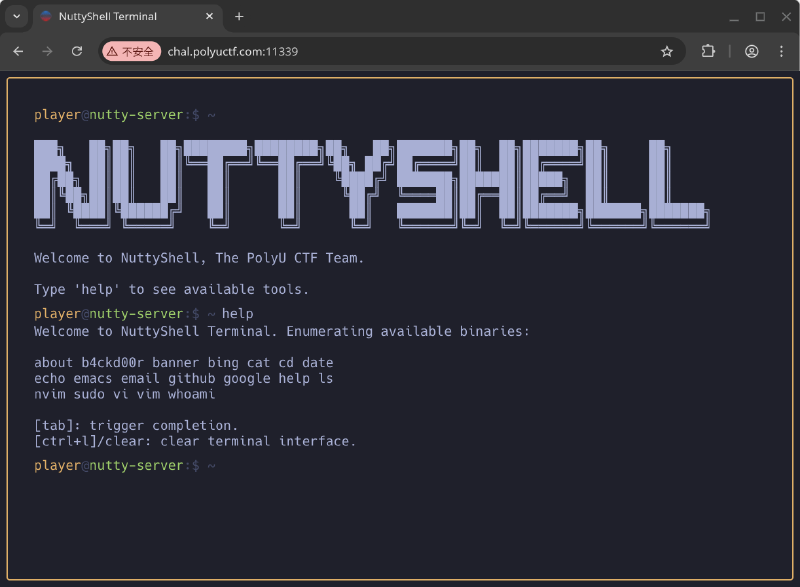
Upon closer inspection, I found out that the website was built with Next.js, with Webpack as the bundler. In additional, I’ve also stumble across the implementation of the commands.
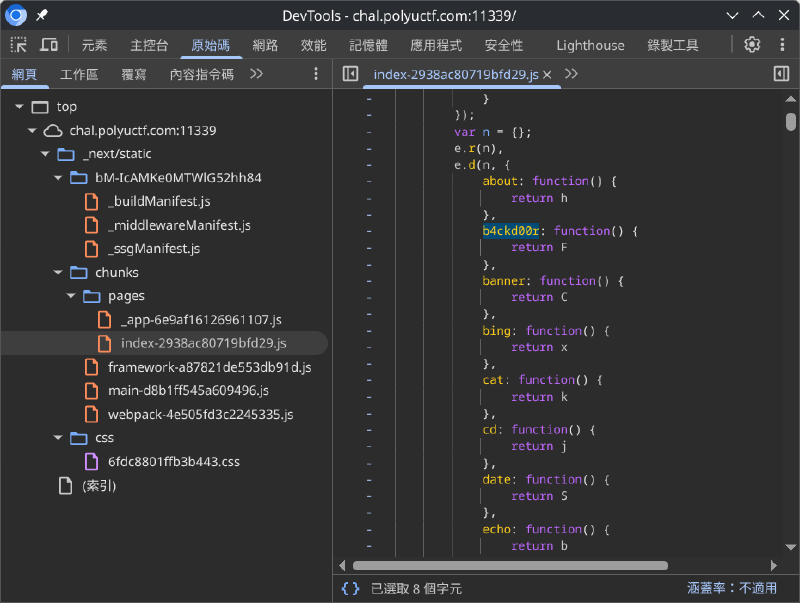
index.js fileAfter deobfuscated the index.js file (with the help from LLM 😄), I discovered a very suspicious dynamic import(). The target module will only be imported if the b4ckd00r command was called with non-empty arguments.
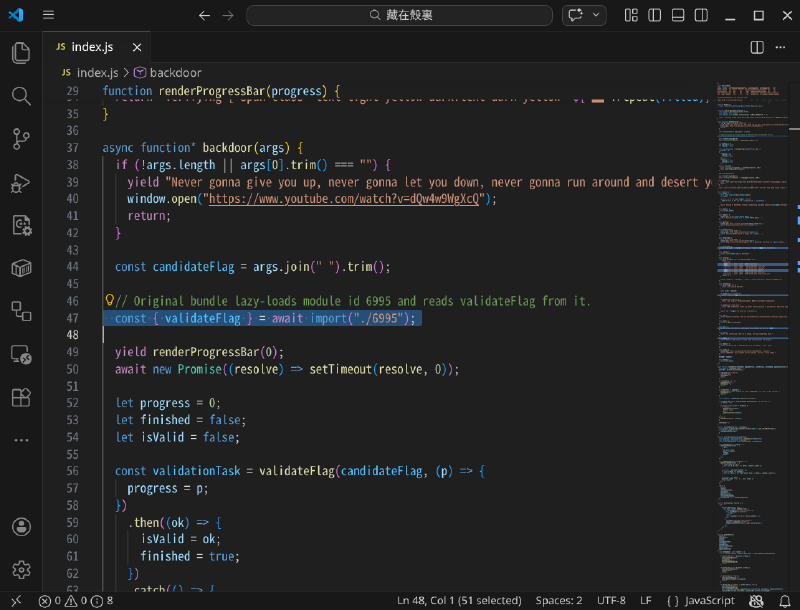
index.jsWhen I add an argument after the b4ckd00r command, lo and behold, the behaviour changed and new scripts (plus a WebAssembly module) are loaded! They are 995.js, wasm-worker.js, wasm_validator.js and wasm_validator_bg.wasm, the latter three are inside a Web Worker.
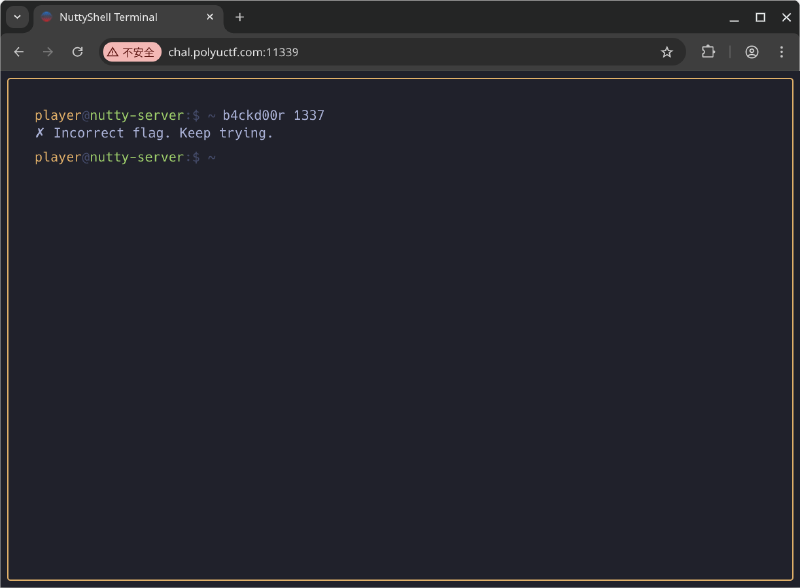
b4ckd00r command with arguments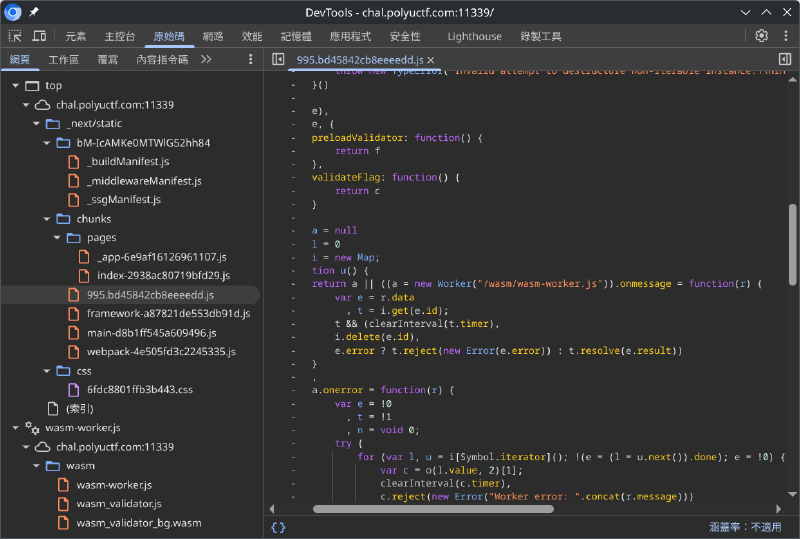
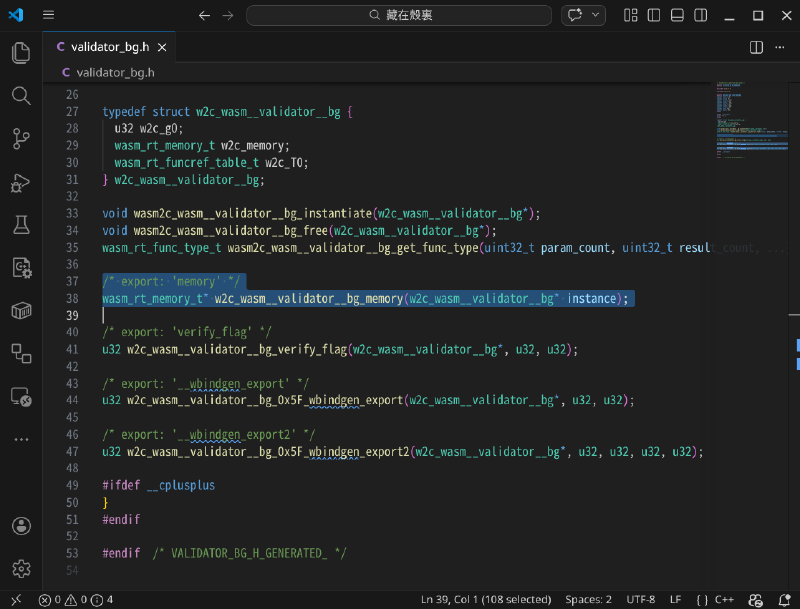
From the worker script, I can see that the validation is done asynchronously as a background via the WebAssembly module. Even though the decompiled C code of the WebAssembly module are not very useful, its C header give me valuable insight on the exported objects. This might be enough to reverse the flag. Let’s start cracking!
Solution#
Based on the validator from the worker, I build a minimal version of it while also exposed the internal memory of the WebAssembly module:
import fs from "node:fs";

const { instance } = await WebAssembly.instantiate(fs.readFileSync("wasm_validator_bg.wasm"), {});
const validator = instance.exports;
const malloc = validator.__wbindgen_export;

export const memory = validator.memory;

/**
 * @param {string} flag
 * @returns {boolean}
 */
export function verifyFlag(flag)
{
    const buffer = new TextEncoder().encode(flag);
    const pointer = malloc(buffer.length, 1);
    new Uint8Array(validator.memory.buffer).set(buffer, pointer);
    return Boolean(validator.verify_flag(pointer, buffer.length));
}
With this, I can write a cracker script to read the memory after invoked the verifyFlag() function:
import { argv } from "node:process";
import { memory, verifyFlag } from "./validator.js";

const FLAG_PATTERN = /PUCTF26\{[A-Za-z0-9_]+_[a-fA-F0-9]{32}\}/g;

const input = argv.slice(2).join(" ");
console.log("verifyFlag(%o)", input);
console.log("// %o", verifyFlag(input));

console.log();

const memoryString = new TextDecoder("latin1").decode(new Uint8Array(memory.buffer));
const flags = Array.from(memoryString.matchAll(FLAG_PATTERN)).map((matches) => matches[0]);
console.log("Flags in memory:");
flags.forEach((flag) => console.log("- %o", flag));
Then you can get the flag by running the script:
> node flag-cracker
verifyFlag('')
// false

Flags in memory:
- 'PUCTF26{C4t_c4T_7h3_w45M_6c138b4309f10ce058582896f8d2e581}'

> node flag-cracker 'PUCTF26{C4t_c4T_7h3_w45M_6c138b4309f10ce058582896f8d2e581}'
verifyFlag('PUCTF26{C4t_c4T_7h3_w45M_6c138b4309f10ce058582896f8d2e581}')
// true

Flags in memory:
- 'PUCTF26{C4t_c4T_7h3_w45M_6c138b4309f10ce058582896f8d2e581}'
- 'PUCTF26{C4t_c4T_7h3_w45M_6c138b4309f10ce058582896f8d2e581}'
- 'PUCTF26{C4t_c4T_7h3_w45M_6c138b4309f10ce058582896f8d2e581}'
Final Flag#
PUCTF26{C4t_c4T_7h3_w45M_6c138b4309f10ce058582896f8d2e581}